Dual Core Mac Os X Sierra Download
Which Macs are compatible with macOS High Sierra (10.13)? What are the system requirements? Which Macs support HEVC?
On June 5, 2017, Apple previewed macOS High Sierra. It was bachelor as a "public beta" starting on June 26, 2017, and was released as a final product on September 25, 2017.
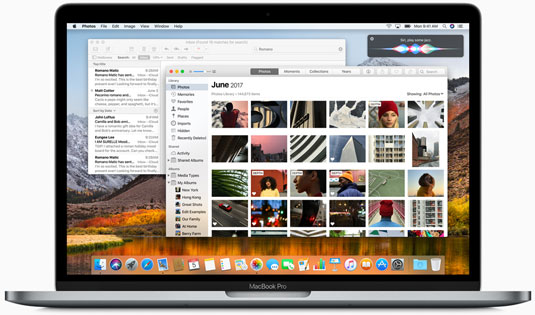
Photo Credit: Apple, Inc. (macOS Loftier Sierra on MacBook Pro)
macOS High Sierra is a free release and the final version merely volition be available officially via Apple's own App Store.
New macOS High Sierra Features
Long-term Mac users can approximate that macOS High Sierra (10.xiii) is a refinement of macOS Sierra (10.12) because of the naming structure.
Just as Mac OS X "Snowfall Leopard" (ten.6) was a refinement of Mac Os X Leopard (ten.5) and Bone X Mountain Lion (10.8) was a refinement of OS X King of beasts (10.7), rather than offering radical new features, macOS High Sierra (10.xiii) is a refinement of macOS Sierra (10.12), likewise.
In the corporate press release, Apple tree uses the word "refine" 5 times and further summarizes macOS Loftier Sierra as offer:
An all-new file system, back up for High-Efficiency Video Coding (HEVC) and an update to Metal, Apple tree'due south advanced graphics technology that powers everything from machine learning to virtual reality content creation. macOS High Sierra likewise includes a number of refinements to the apps Mac users enjoy every day, including Photos, Safari and Mail.
Although that may not sound exciting, the all-new file organisation (APFS) is promised to provide "enhanced performance, security, and reliability" (at least initally on SSDs as the beta support for difficult drives and "Fusion" Drives was removed in the final version), HEVC promises to provide 4K video that is "upwardly to 40 percent smaller" than the electric current H.264 standard, and Metal 2 promises improved graphics performance and back up for external graphics processors ("planned for leap 2018"), also.
These improvements may not be sexy, merely they're definitely worthwhile.
Organization Requirements
In Apple'southward WWDC 2017 presentation and elsewhere, the company notes that macOS High Sierra runs on the aforementioned Mac categories as macOS Sierra before it:
- iMac (Tardily 2009 or later)
- MacBook (Late 2009 or later)
- MacBook Air (Late 2010 or subsequently)
- MacBook Pro (Mid-2010 or later)
- Mac mini (Mid-2010 or later)
- Mac Pro (Mid-2010 or later)
In addition to being i of the categories of Mac listed higher up, it also needs to be running OS X Mountain Lion (10.viii) or college prior to installation and have 2 GB of memory installed.
All of these Macs back up HEVC, just not all of them support hardware accelerated HEVC.
In fine print, Apple notes that for hardware accelerated HEVC support, merely "sixth generation" and newer Intel processors are supported. More precisely, that would exist this much smaller number of Macs:
- iMac 21.5-Inch (Mid-2017 or later)
- iMac 27-Inch (Late 2015 or later)
- iMac Pro (Late 2017 or later)
- MacBook (Early 2016 or later)
- MacBook Pro (Late 2016 or later)
Furthermore, but Macs with "Kaby Lake" processors -- released in 2017 -- support hardware accelerated HEVC with 10-chip color:
- iMac 21.v-Inch (Mid-2017 or later)
- iMac 27-Inch (Mid-2017 or subsequently)
- iMac Pro (Late 2017 or later)
- MacBook (Mid-2017 or subsequently)
- MacBook Pro (Mid-2017 or later)
Identification Help
If you're not sure if your Mac will run macOS High Sierra, all of the supported systems tin can exist identified past the above "subfamily" designations also as by the Model Identifier in software. More than details about specific identifiers are provided in EveryMac.com's extensive Mac Identification section.
To locate the model identifier, select "About This Mac" under the Apple tree Menu on your computer and click the "More Info..." button. If the Mac is running OS X "Lion" (ten.seven) or subsequently, click the "System Report" push afterward clicking "More than Info..." also.
EveryMac.com's Ultimate Mac Lookup feature -- as well as the EveryMac app -- also can identify these models by their Serial Numbers.
macOS Loftier Sierra Supported Systems
Specifically, the post-obit Macs are compatible with macOS Loftier Sierra. However, simply considering a Mac runs macOS High Sierra does not mean that information technology is compatible with hardware accelerated HEVC.
| High Sierra Supported Mac | Subfamily | Model ID |
| Late 2009 | ||
| Late 2009 | ||
| Late 2009 | ||
| Late 2009 | ||
| Tardily 2009 | ||
| Belatedly 2009 | ||
| Mid-2010 | ||
| Mid-2010 | ||
| Mid-2010 | ||
| Mid-2010 | ||
| Mid-2010 | ||
| Mid-2010 | ||
| Mid-2010 | ||
| Mid-2011 | ||
| Mid-2011 | ||
| Mid-2011 | ||
| Mid-2011 | ||
| Mid-2011 | ||
| Mid-2011 | ||
| Late 2011 (Edu) | ||
| Late 2012 | ||
| Late 2012 | ||
| Late 2012 | ||
| Late 2012 | ||
| Late 2012 | ||
| Late 2012 | ||
| Early 2013 (Edu) | ||
| Late 2013 | ||
| Late 2013 | ||
| Late 2013 | ||
| Late 2013 | ||
| Late 2013 | ||
| Late 2013 | ||
| Mid-2014 | ||
| Retina 5K, Late 2014 | ||
| Retina 5K, Late 2014 | ||
| Retina 5K, Mid-2015 | ||
| Belatedly 2015 | ||
| Late 2015 | ||
| Retina 4K, Late 2015 | ||
| Retina 4K, Late 2015 | ||
| Retina 5K, Late 2015 | ||
| Retina 5K, Late 2015 | ||
| Retina 5K, Late 2015 | ||
| Mid-2017 | ||
| Retina 4K, Mid-2017 | ||
| Retina 4K, Mid-2017 | ||
| Retina 4K, Mid-2017 | ||
| Retina 5K, Mid-2017 | ||
| Retina 5K, Mid-2017 | ||
| Retina 5K, Mid-2017 | ||
| Retina 5K, Mid-2017 | ||
| Late 2009 | ||
| Mid-2010 | ||
| Early 2015 | ||
| Early 2015 | ||
| Early 2015 | ||
| Early 2016 | ||
| Early 2016 | ||
| Early on 2016 | ||
| Mid-2017 | ||
| Mid-2017 | ||
| Mid-2017 | ||
| Late 2010 | ||
| Belatedly 2010 | ||
| Late 2010 | ||
| Late 2010 | ||
| Mid-2011 | ||
| Mid-2011 | ||
| Mid-2011 | ||
| Mid-2011 | ||
| Mid-2011/Edu Only** | ||
| Mid-2012 | ||
| Mid-2012 | ||
| Mid-Edu But** | ||
| Mid-2012 | ||
| Mid-2012 | ||
| Mid-2013 | ||
| Mid-2013 | ||
| Mid-2013 | ||
| Mid-2013 | ||
| Early on 2014 | ||
| Early 2014 | ||
| Early on 2014 | ||
| Early 2014 | ||
| Early 2015 | ||
| Early 2015 | ||
| Early 2015 | ||
| Early 2015 (2017)** | ||
| Early 2015 | ||
| Mid-2010 xiii" | ||
| Mid-2010 13" | ||
| Mid-2010 fifteen" | ||
| Mid-2010 15" | ||
| Mid-2010 fifteen" | ||
| Mid-2010 15" | ||
| Mid-2010 17" | ||
| Mid-2010 17" | ||
| Mid-2010 17" | ||
| Early 2011 13" | ||
| Early 2011 xiii" | ||
| Early 2011 fifteen" | ||
| Early on 2011 15" | ||
| Early 2011 fifteen" | ||
| Early on 2011 17" | ||
| Early 2011 17" | ||
| Late 2011 13" | ||
| Late 2011 xiii" | ||
| Late 2011 15" | ||
| Late 2011 15" | ||
| Late 2011 xv" | ||
| Late 2011 17" | ||
| Tardily 2011 17" | ||
| Mid-2012 13" | ||
| Mid-2012 13" | ||
| Mid-2012 xv" | ||
| Mid-2012 xv" | ||
| Mid-2012 15" | ||
| Retina Mid-2012 | ||
| Retina Mid-2012 | ||
| Retina Mid-2012 | ||
| Retina Late 2012 | ||
| Retina Tardily 2012 | ||
| Retina Early 2013 | ||
| Retina Early 2013 | ||
| Retina Early 2013 | ||
| Retina Early 2013 | ||
| Retina Early 2013 | ||
| Retina Late 2013 xiii" | ||
| Retina Late 2013 13" | ||
| Retina Late 2013 xiii" | ||
| Retina Belatedly 2013 15" | ||
| Retina Late 2013 xv" | ||
| Retina Late 2013 15" | ||
| Retina Late 2013 15" | ||
| Retina Late 2013 15" | ||
| Retina Mid-2014 13" | ||
| Retina Mid-2014 13" | ||
| Retina Mid-2014 13" | ||
| Retina Mid-2014 15" | ||
| Retina Mid-2014 15" | ||
| Retina Mid-2014 15" | ||
| Retina Mid-2014 fifteen" | ||
| Retina Mid-2014 15" | ||
| Retina Early on 2015 13" | ||
| Retina Early 2015 13" | ||
| Retina Early on 2015 thirteen" | ||
| Retina Mid-2015 15" | ||
| Retina Mid-2015 15" | ||
| Retina Mid-2015 15" | ||
| Retina Mid-2015 15" | ||
| Retina Mid-2015 15" | ||
| Belatedly 2016 xiii" | ||
| Late 2016 13" | ||
| Late 2016 13" | ||
| Belatedly 2016 13" | ||
| Late 2016 13" | ||
| Late 2016 15" | ||
| Late 2016 fifteen" | ||
| Late 2016 15" | ||
| Mid-2017 xiii" | ||
| Mid-2017 xiii" | ||
| Mid-2017 13" | ||
| Mid-2017 13" | ||
| Mid-2017 13" | ||
| Mid-2017 15" | ||
| Mid-2017 15" | ||
| Mid-2017 xv" | ||
| Mid-2010 | ||
| Mid-2010 | ||
| Mid-2010 | ||
| Mid-2011 | ||
| Mid-2011 | ||
| Mid-2011 | ||
| Mid-2011 | ||
| Tardily 2012 | ||
| Belatedly 2012 | ||
| Late 2012 | ||
| Tardily 2012 | ||
| Late 2012 | ||
| Late 2014 | ||
| Late 2014 | ||
| Tardily 2014 | ||
| Belatedly 2014 | ||
| Mid-2010 | ||
| Mid-2010 | ||
| Mid-2010 | ||
| Mid-2010 | ||
| Mid-2010 | ||
| Mid-2010 | ||
| Server Mid-2010 | ||
| Server Mid-2010 | ||
| Server Mid-2010 | ||
| Server Mid-2010 | ||
| Server Mid-2010 | ||
| Server Mid-2010 | ||
| Mid-2012 | ||
| Mid-2012 | ||
| Mid-2012 | ||
| Mid-2012 | ||
| Mid-2012 | ||
| Server Mid-2012 | ||
| Server Mid-2012 | ||
| Server Mid-2012 | ||
| Server Mid-2012 | ||
| Server Mid-2012 | ||
| Late 2013 | ||
| Late 2013 | ||
| Late 2013 | ||
| Late 2013 |
If your Mac isn't listed to a higher place, and it wasn't introduced after the release of macOS High Sierra in September 2017, it isn't uniform with the operating arrangement.
macOS High Sierra Hardware Accelerated HEVC Compatibility
All of the above Macs support the macOS High Sierra operating organisation, only only the following support HEVC hardware acceleration:
| Hardware Accelerated HEVC | Subfamily | Model ID |
| Retina 5K, Late 2015 | ||
| Retina 5K, Late 2015 | ||
| Retina 5K, Tardily 2015 | ||
| Mid-2017 | ||
| Retina 4K, Mid-2017 | ||
| Retina 4K, Mid-2017 | ||
| Retina 4K, Mid-2017 | ||
| Retina 5K, Mid-2017 | ||
| Retina 5K, Mid-2017 | ||
| Retina 5K, Mid-2017 | ||
| Retina 5K, Mid-2017 | ||
| Early 2016 | ||
| Early 2016 | ||
| Early 2016 | ||
| Mid-2017 | ||
| Mid-2017 | ||
| Mid-2017 | ||
| Tardily 2016 13" | ||
| Late 2016 13" | ||
| Late 2016 13" | ||
| Late 2016 13" | ||
| Belatedly 2016 13" | ||
| Late 2016 xv" | ||
| Late 2016 xv" | ||
| Tardily 2016 15" | ||
| Mid-2017 13" | ||
| Mid-2017 13" | ||
| Mid-2017 13" | ||
| Mid-2017 13" | ||
| Mid-2017 13" | ||
| Mid-2017 15" | ||
| Mid-2017 15" | ||
| Mid-2017 15" |
Only the models released in 2017 support hardware accelerated HEVC with x-bit colour:
| Hardware Accelerated x-flake HEVC | Subfamily | Model ID |
| Mid-2017 | ||
| Retina 4K, Mid-2017 | ||
| Retina 4K, Mid-2017 | ||
| Retina 4K, Mid-2017 | ||
| Retina 5K, Mid-2017 | ||
| Retina 5K, Mid-2017 | ||
| Retina 5K, Mid-2017 | ||
| Retina 5K, Mid-2017 | ||
| Mid-2017 | ||
| Mid-2017 | ||
| Mid-2017 | ||
| Mid-2017 13" | ||
| Mid-2017 13" | ||
| Mid-2017 13" | ||
| Mid-2017 13" | ||
| Mid-2017 xiii" | ||
| Mid-2017 15" | ||
| Mid-2017 15" | ||
| Mid-2017 15" |
If your Mac isn't listed above, and information technology wasn't introduced after the release of macOS Loftier Sierra on September 25, 2017, it doesn't support HEVC hardware acceleration.
macOS Loftier Sierra Summary
Ultimately, it would be wise to wait for performance reports and a couple of issues fixes before upgrading a mission critical Mac, simply for those who have a Mac that is uniform with macOS Sierra, the refinements in functioning, security, and reliability brand macOS High Sierra a welcomed upgrade.
EveryMac.com is provided "as is" without warranty of any kind any. EveryMac.com, and the writer thereof, shall non be held responsible or liable, under any circumstances, for any damages resulting from the use or inability to use the data within. For consummate disclaimer and copyright information please read and understand the Terms of Use and the Privacy Policy before using EveryMac.com. Apply of whatever content or images without expressed permission is not allowed, although links to whatsoever page are welcomed and appreciated.
Dual Core Mac Os X Sierra Download
Posted by: candywifelle.blogspot.com